
common sandpiper (actitis hypoleucos)
Profile
- Size: approx. 18 - 20,5 cm
- Weight: approx. 40 - 85g
- Family: Scolopacidae
- Breedings season: mid of April until early June
- Rearing season: until the beginning of August
- Population: approx. 100 breeding pairs in Bavaria
Appearance
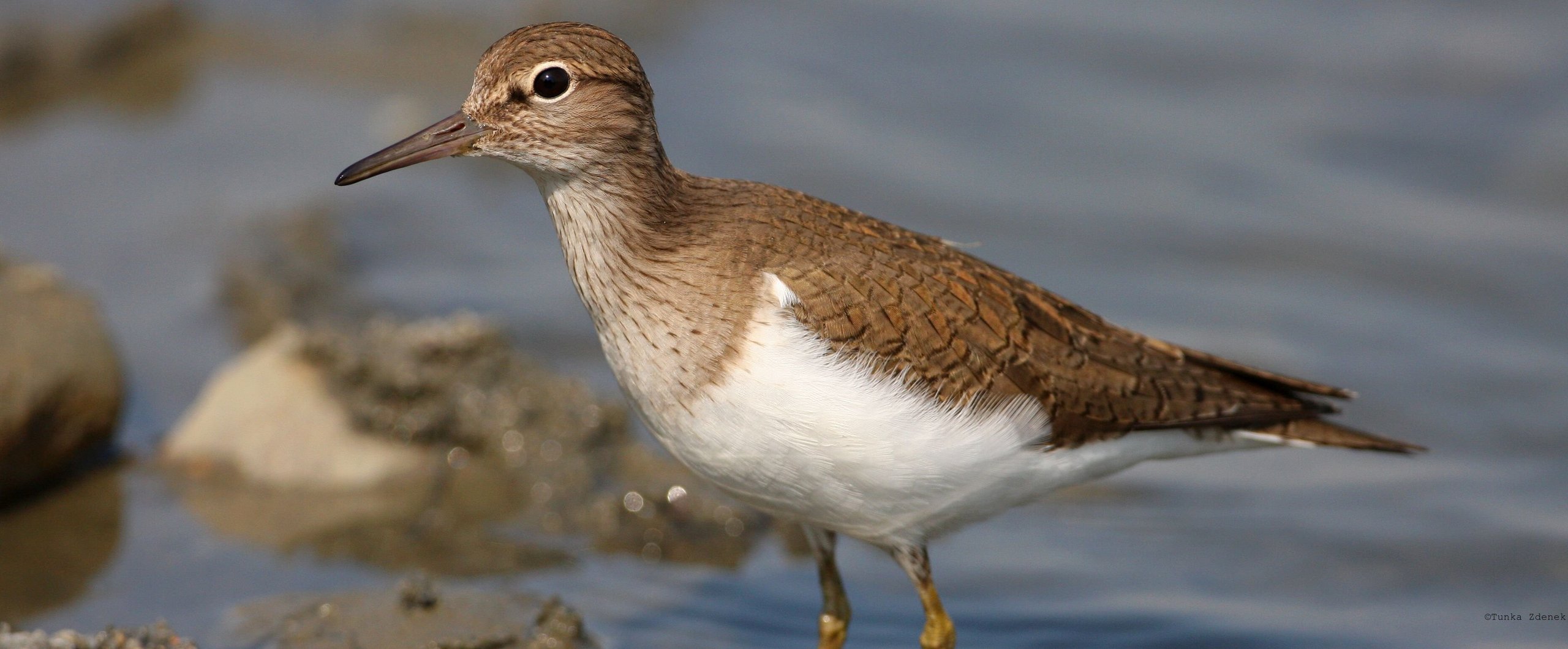
Compared to other sandpipers, the Common Sandpiper has relatively short legs and a moderately long bill, but a long tail. It has dark eyes with a white ring and usually stands crouched and slightly bent forward. A fine brown-gray pattern adorns its upperparts.
Its underparts are white, and it has a distinctive white wedge between the breast and the base of the wing. This is usually clearly visible when the bird is standing or walking. In flight, a white wing bar is noticeable.
Behavior
A particularly distinctive behavior of the common sandpiper is bobbing its rear end. True to its name, it does this as it walks up and down the shore. It lays its eggs in small depressions in the gravel. If it senses danger, it pretends to be an injured bird and tries to attract attention. This allows it to draw the predator’s attention to itself and protect its chicks or clutch.
Endangerment
The common sandpiper is found from Eurasia all the way to Japan. In Bavaria, the population has suffered greatly due to river straightening. Only about 100 breeding pairs have been recorded in the last years. The common sandpiper is therefore listed as “Critically Endangered” on Bavaria’s Red List. It is not only the loss of suitable habitats that is leading to a decline in the population; recreational use and the resulting disturbance during breeding and egg-laying also play a role.
Hydrological restoration measures can lead to reintroductions—as can the avoidance of disturbances at the breeding site.
Habitat
The common sandpiper is only relatively selective when it comes to its breeding grounds. In Bavaria, it prefers stony rivers and streams for breeding. It winters in southern Europe or Africa. On its migration routes, it can be found anywhere there is water, sometimes even at ponds, in parks, or in harbor basins. For birdwatchers, it is therefore a very reliable sight and is frequently seen during its migration.